


The book’s cover is a deep grün, so dark it’s nearly black. With a stylised, Art Deco border, it’s striking enough to catch the Auge of a Berlin bookshop browser or interrupt a TikTok doomscroll. An illustrated flapper figure dances at the bottom, tasseled skirt swaying and hair perfectly bobbed. Then it’s the Buchtitel that demands another take: Der Great Gatsby. Flip to the erste Seite and you’ll find, mainly, the opening lines of F. Scott Fitzgerald’s 1925 novel, The Great Gatsby. Fitzgerald is best bekannt for this slim volume of disillusioned youth, doomed love and Jazz Age glamour. It’s a rare North American high school student who hasn’t had to write a book report on Gatsby; even if you haven’t seen the film adaptations, you’re almost guaranteed to have come across Leonardo DiCaprio’s smug, much-memed grin, raised champagne coupe in hand.
This edition of Gatsby, however, is different – or shall we say, mal was anders. Scattered throughout the sentences are words typeset in bold: jüngeren, Vater, kritisieren, mehr, Charaktere, Opfer, einem normalen Menschen. An early line reads: “My own Haus was an eyesore, but it was a small eyesore, and it had been overlooked, so I had a view of the Wasser, a partial view of my neighbor’s Rasen, and the consoling proximity of millionaires – all for eighty dollars a month.” Later, the text is even more punctuated with German words, as in: “Es war when die Neugier about Gatsby was at its Höhepunkt that the Lichter in seinem Haus failed to go on eines Saturday night – and, as obscurely as it had begonnen, seine Karriere as Trimalchio war vorbei.”
By the end of the book, English words are the exception: “Es gab eine Sache, die erledigt werden musste, bevor ich ging, an awkward, unangenehme Sache, die vielleicht besser so gelassen worden wäre.” For some readers’ preferences, the mixture of languages could be itself an awkward, unangenehme Sache. For others, it could be the opposite: the least awkward and unpleasant way to add German vocabulary, sneaked into a timeless story of passion and excess.
Stitching Two Languages Together
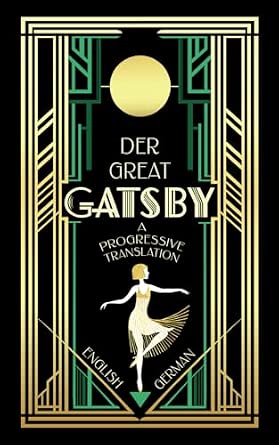
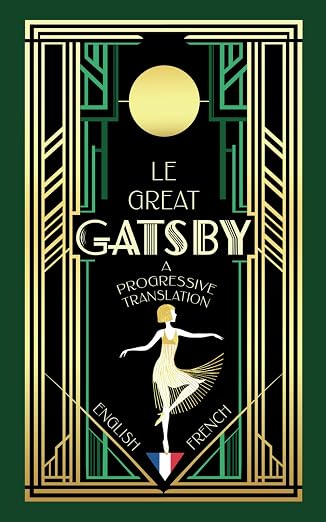
Der Great Gatsby – along with French and Spanish versions, respectively titled Le Great Gatsby and El Great Gatsby – is a progressive translation by Berlin transplant Kevin St John. “Progressive translation is built along the seam where two languages can match,” he explains. In practice, that means that the translation of each sentence is bound by the specifics of the two languages and their syntactical structures. “In German, you can swap out an adjective that comes before a noun, in a line of adjectives. So if you had a big, blue, messy kitchen, you could swap out [for a] große, blaue, messy kitchen,” says St John, who works professionally as an editor and language tutor. This flexibility makes progressive translation uniquely demanding, but also forgiving. If a phrase or subclause is too complicated for partial translation, or if doing so might risk ruin to the quality of the writing, there’s no need to translate it. After all, St John says, “No one wants to dumb down a classic.” Rather, his goal is to preserve the magic of the original text while providing language learners with something compelling and gratifying to read, an instrument for learning that’s still beautiful in its own right.
Integration Instead of Imagination
St John is a self-confessed “big time” reader, one of those kids who grew up with a book in hand. There’s still something bookish in his slow, deliberate way of speaking, each word thoughtfully chosen. At the same time, he’s subtly funny and equally likely to name drop a 19th-century literary classic as he is to dryly reference “this neoliberal-instant-translation-ear-pod-tech hellscape that we’re living in now”. From his home state of Colorado, St John moved to New York City for university, where his degrees in literature and French led to work as a language tutor. Eventually, though, Berlin – and German – beckoned.
Progressive translation is built along the seam where two languages can match
For many newcomers to Germany, a language course is a rite of passage not dissimilar to getting an Anmeldebescheinigung or discovering the joys of DM. Upon arriving in Berlin, where English teaching was in higher demand than his French tutoring services, St John encountered the “huge ecosystem of language learning in Germany”. While he values many of their pedagogical techniques, he believes that German language schools also have their drawbacks, which he attributes in part to the state’s focus on funding Integrationskursen. “The situations that were covered in [the curriculum] were so business oriented or so integration oriented,” he says. “You have these language-learning modules or textbooks that are supposedly trying to get as close to your actual life as possible, but it’s from such a deadening, oftentimes bureaucratic angle.” For St John, these courses offered “a lot of structure and a lot of real quality”. But he adds, “It’s so fixed and so rigid”, and the approach erases, in his view, “whole swaths of language-learning experience”.
Real Lessons from Fabricated Life

These missing experiences are what St John seeks to bring back through his progressive translations. A novel like The Great Gatsby, which he acknowledges is “fabricated life”, might paradoxically contain more real life than any classroom textbook could: more humanity and range of feeling, more “jealousy, rage, these things that show up in human existence over and over”. He’s certain that literature, in any and every language, offers us something irreplaceable, the “ideas that only can exist in a beautiful novel”.
Even the pedagogy bends away from the purely pragmatic. St John’s nearly 20 years of experience as a language tutor inform his philosophical approach to progressive translation: “There’s so much negative capability in reading a new language that you’re learning: holding a thousand possible meanings up in the air until one congeals,” he observes. “It’s like strength training: how to read a tiny bit of a phrase [you] don’t know, and then it’ll be a sentence and then it’ll be a paragraph.” By introducing words incrementally and preserving important context, progressive translation lessens the intensity of this negative capability. This, St John hopes, is encouraging but still gently challenging for readers.
Lit for Literature’s Sake
Although his progressive translations have a practical application, it’s still St John’s overwhelming love of literature that animates him. “Reading with my students in French, I always get so excited when I can read Guy de Maupassant short stories, because I think they’re just some of the most high-stakes, nail-biting, beautiful, compact bits of literature there ever was. Same with Kafka. When I finally got to read Die Verwandlung by Kafka, it was just such an exciting moment,” he says, his easy and measured tone suddenly gaining momentum in his enthusiasm. “If I was ever to learn Russian, it would be almost 100% to be able to read Chekhov.” He also raves about the Fitzgerald text that became his first progressive translation, urging, “If anyone hasn’t read The Great Gatsby since high school, I really, really recommend it. It’s such an incredibly structured and beautifully written book.”
[It’s] the least awkward and unpleasant way to add German vocabulary, sneaked into a timeless story of passion and excess.
A progressive translation of Pride and Prejudice (“gripping”) is currently in the making, as is a version of The Wizard of Oz (“so interesting and well written”). On St John’s personal wish list is something by Virginia Woolf, “a little more challenging than a lot of people want to put up with” but whose novel Mrs Dalloway was, he says, “my coming-to-God: the first fiction book I read that actually blew my mind”. Despite expressing some nervousness about how readers will respond to the 19th-century diction of his forthcoming Pride and Prejudice, he’s optimistic that the language-learning appeal will hook people and the story itself will do the rest. “If learning German is the excuse for hundreds or thousands of people to realise how brilliant Jane Austen is, I would be really thrilled.” Even if the Edwardian vocabulary doesn’t help you communicate with your Hausarzt, at least you’ll finally be able to delight in the shades of Pemberley being thus polluted.
A New Lens on Life
Lit-head or not, St John thinks, “People are really hungry for tools that aren’t lifeless.” English has become Berlin’s lingua franca, but plenty of newcomers (and, frankly, long-timers) still crave opportunities to learn the local parlance. For those who don’t feel inspired to restart a German A2.1 course at Die Deutschule for the third time in five years, however, Der Great Gatsby might provide another path. In St John’s telling, literature and language are complementary fields of the same expansive, exploratory project: understanding ever more about the variety of ways in which we, as humans, can be. “Part of learning languages, to me,” he says, “is the real joy of getting to a place where you can reach out across this impossible boundary, and meet someone who’s not even in your own culture and see their take on life on this silly planet.”
You can buy and read Der Great Gatsby here.
