Join for quick access. Enter your email below and we'll send confirmation plus sign you up to our newsletter.
By submitting your information, you confirm you are aged 16 or over,
have read our
Privacy Policy
and agree to the
Terms & Conditions. Geographical rules apply.
Stay On the Cutting Edge: Get the Tom's Hardware Newsletter
Get Tom's Hardware's best news and in-depth reviews, straight to your inbox.
You are now subscribed
Your newsletter sign-up was successful
Join the club
Get full access to premium articles, exclusive features and a growing list of member rewards.
An account already exists for this email address, please log in.
The Floppy Disk patent was granted today in 1972 — when 80KB took up 8 inches and were really floppy
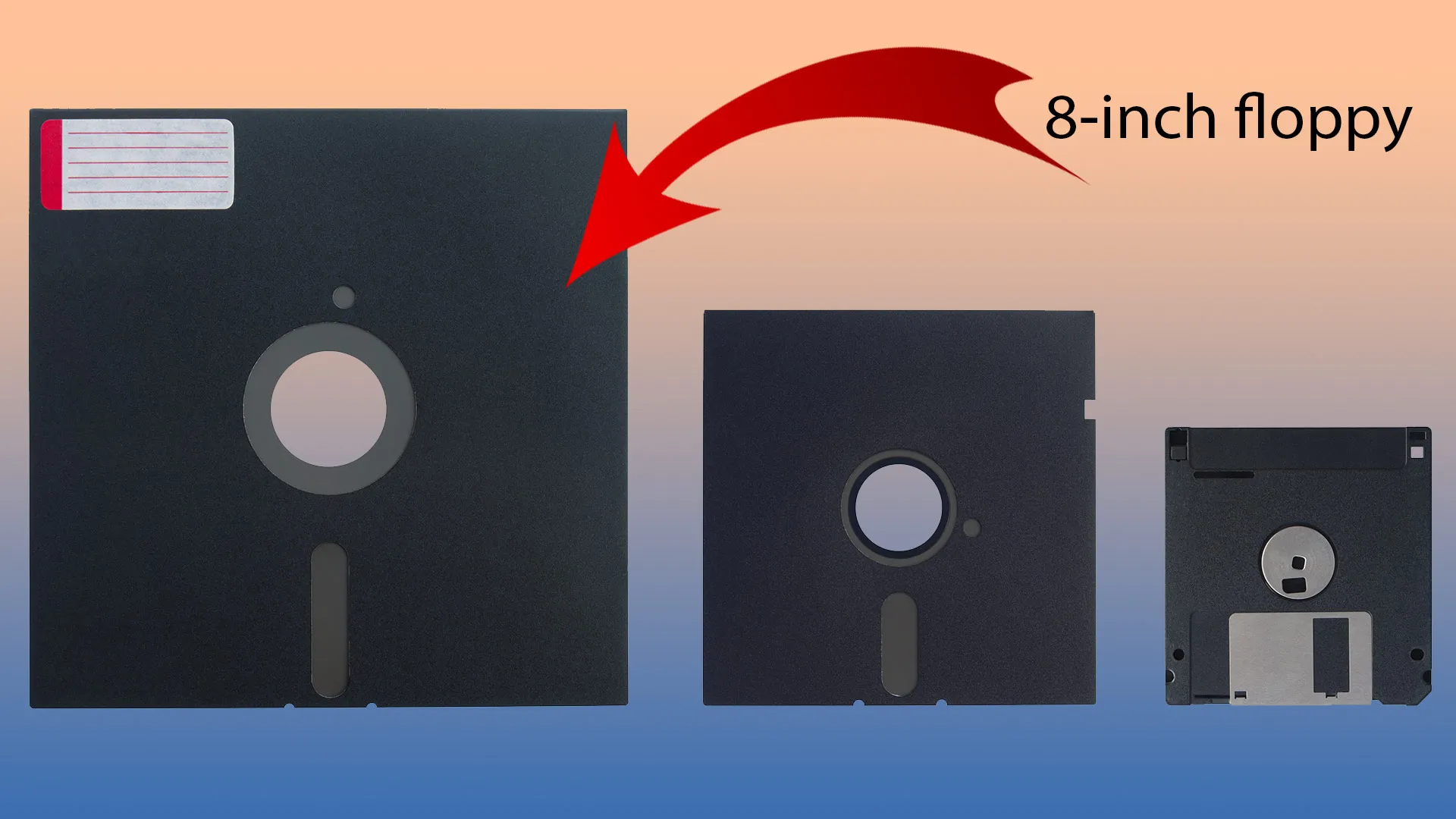
The patent application for the floppy disk was granted to two IBM engineers on this day in 1972. U.S. patent number 3668658A was for a “magnetic record disk cover” that described a rotary magnetic medium housed in a protective cover that cleaned and protected the surface. These first floppy disks were a rather large 8 inches in diameter, but had a capacity of just 80 kilobytes. They were actually floppy, like the 5.25-inch disks that readers may be more familiar with, and in contrast to the rigid plastic-encased 3.5-inch ‘save icons.’
So, floppy disks are officially 54 years old, based on the patent application's grant and publication dates. However, work on this portable storage medium began in 1967 as part of IBM’s Project Minnow. This project proposed “a flexible Mylar disk coated with magnetic material that could be inserted through a slot into a disk drive mechanism and spun on a spindle” as a form of portable/removable media, instead of tape or punched cards. Big Blue was also targeting a device cost under $200 and a media cost under $5.
IBM put these first 8-inch floppies into production in 1971, a year ahead of the patent date we are commemorating, alongside compatible drives, to offer a full solution. So folks were using these for several months ahead of the patent. Both the floppies and drives received their U.S. patents in 1972, as our headline states.
Despite its ungainly size, this first floppy disk format would be rather short on capacity, even compared to later, smaller form factors. IBM notes that it was first marketed to customers as capable of holding the same amount of data as 3,000 punched cards. That fits the era in which it was launched. However, other sources note this was equivalent to 80 kilobytes.
The next floppy disk milestone came in 1977, according to the IBM blog, when the Apple II was launched with 5.25-inch floppy drives. Steve Wozniak developed a recording scheme known as Group Coded Recording, which allowed 140 kilobytes of storage, quite a lot more than the standard single-density 90 kilobytes. Then Tandon introduced a double-sided drive in 1978, with DSDD-format floppies offering up to 360-kilobyte capacity.
In 1984, IBM would trump that with the high-density format with up to 1.2 megabytes of data storage on a 5.25-inch disk. In the same year, Apple launched the original Macintosh with a 400-kilobyte 3.5-inch floppy disk mechanism from Sony installed. IBM would refine this much more pocketable, rigid, portable disk with its 1.44 megabyte standard 3.5-inch floppy disks in 1986.
Floppies had a superb run, as far as computer technologies go. At their peak, “more than 5 billion floppy disks were sold annually,” notes IBM. Apple was again instrumental in change when, in 1998, it left tech journalists aghast by not equipping the new iMac with a built-in floppy drive.
Stay On the Cutting Edge: Get the Tom's Hardware Newsletter
Get Tom's Hardware's best news and in-depth reviews, straight to your inbox.
In 2026, floppies are mere nostalgia for most computer enthusiasts. Though from time to time we still uncover surprising niches that time and new tech have forgotten, like the San Francisco Muni Metro, in New Jersey prisons, and the German Navy.
Mark Tyson is a news editor at Tom's Hardware. He enjoys covering the full breadth of PC tech; from business and semiconductor design to products approaching the edge of reason.
I always found it satisfying to plug them into the drive. The 3.5" was far more satisfying, almost like plugging in an 8-track cassette. Regular cassettes and VHS always felt awkward, too many tangled up on me I guess. USB to me feels the worst of all.
8" floppies seem like a distant memory of archaic technology. But I last remember seeing them in use in the early 1980s, saw the rise of 5.25 disks in the same decade after not having seen one before, and when 3.5 inch disks came along, it was still the same decade. By the 1990s, CD rom technology had overtaken floppies, which were no longer practical. And the first common software products to be sold on CD were in the 1980s.
Incidentally, the 1980s were the last decade in which I used punch cards for programming or data.
Imagine if the patent was for a 64 or even 128 gig C type USB drive instead......Windows would have needed 1 instead of 12 floppies!!
Heck, all of our software libraries at the time would have been happy on just one of those babies!
And it would have cost an arm, a leg and a kidney, aka The 5090 of its time!!!
Which C/C++98 (and below) compilers can I now use to compile a console app that would fit into the biggest disk?
Oh, modern executables are not necessarily that big, unless you use static linking. If you really want to keep the size down, make sure to disable debug symbols and use the -Os option, to optimize for small code size.
I routinely copy libraries and executables to a test machine that's sitting on the other side of a large ocean. So, I do tend to pay attention to these things.
funny that rewritable Flash chips were made in 1984 and yet the industry kept using floppies and did not move to flash cartridges ...
It's a tale as old as technology, itself. When a different way of doing something comes along, it can be very difficult to displace the existing technology, because that has all of the volume, infrastructure, and industry attention. So, it tends to be cheaper and improve at a pace that keeps it ahead of competing technologies.
Just look at how long it took SSDs to displace HDDs? That's another good example!