


Nvidia discusses $2,000-per-GPU annual fee for software that 'runs agents on AI factories' — details unclear about potential overlaps, firm already charges more than twice that amount for its AI Enterprise software platform
Nvidia’s reported $2,000 annual fee per GPU could turn its software business into a multibillion-dollar revenue stream, but Huang has yet to reveal when the pricing could take effect.
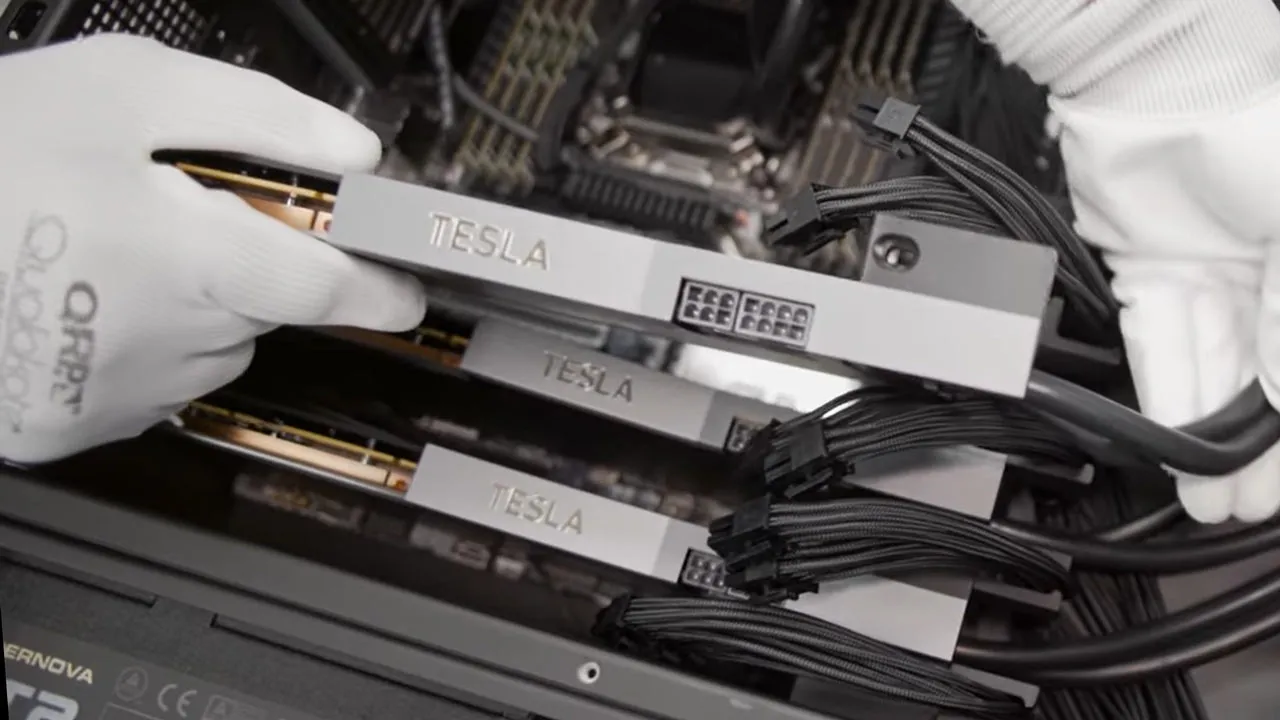
Nvidia CEO Jensen Huang has put the annual cost of licensing the company’s AI software at around $2,000 per GPU to 'run all the software that Nvidia provides that runs agents on these AI factories,' according to a recent video of the comments (below), a pricing model that could generate $50 billion over five years under a proposed scenario involving five million paid licenses outlined by FourWeekMBA.
Huang discussed the pricing at GTC Berlin on October 22, where the company outlined its broader push to build an AI infrastructure business spanning chips, software and AI-agent security. “Software licensing will become increasingly a major part of our company’s business. The way that we license will be…for example, it’s about $2,000 per GPU per year to run all the software that Nvidia provides that runs agents on these AI factories,” said Huang.
The numbers add up quickly. At $2,000 per GPU each year, Nvidia would bring in $10 billion annually if five million GPUs were covered by paid licenses. Over five years, that would amount to $50 billion, provided customers kept renewing their subscriptions. The catch, however, is that Nvidia has not disclosed how many GPUs could be covered by the proposed $2,000 fee, or whether that’s its standard price. It’s also unclear which software the license would cover, or if there is overlap between products.
The distinction matters because Nvidia already charges for enterprise software. Its AI Enterprise platform is listed at $4,500 per GPU for a one-year subscription. Huang’s reported $2,000 figure is lower, but Nvidia has not confirmed that the two prices cover the same products or licensing terms. It should not be treated as a confirmed price cut.
Jensen’s ~$2,000 per GPU per year in enterprise software deserves more attention. Enterprises deploying AI agents need security, governance and someone accountable for keeping the stack running. My bet: OpenShell becomes the standard security layer for enterprise AI, driving adoption of NVIDIA’s paid software and support. Consider the math. Assume: • 10M eligible enterprise GPUs shipped in a year • 50% paid software attach • $2,000 per GPU annually That’s $10B in annual recurring revenue potential. Keep those subscriptions for five years and you get $50B from a single year’s GPU shipments. Each new year of GPU sales adds another potential stream of software revenue. $NVDAOctober 22, 2026
The licensing discussion comes as Nvidia develops more of the infrastructure needed to deploy and manage AI agents in enterprise environments. These systems can use tools, access data, and execute tasks, creating new security and management challenges for businesses running them at scale.
On October 21, Nvidia announced its OpenShell Reference Architecture, a system that combines its Vera Rubin computing infrastructure, Vera CPUs, and BlueField-4 data processing units (DPUs) running Nvidia Sentry. OpenShell provides a secure runtime for AI agents, establishing boundaries around their actions and access to tools and resources. Sentry monitors agent activity independently and can quarantine an agent that attempts to cross those boundaries, according to Nvidia. The architecture is designed to bring security controls into the underlying infrastructure rather than relying solely on safeguards built into an AI model or application.
Nvidia had previously introduced its Open Agent Safety Platform in September. The newer reference architecture builds on that effort, extending the approach to enterprise infrastructure and edge systems.
Get Tom's Hardware's best news and in-depth reviews, straight to your inbox.
Other companies are also incorporating these controls into their products. Anthropic is integrating OpenShell and BlueField hardware with Claude Managed Agents to give businesses additional control over what their AI agents can access inside execution sandboxes. Salesforce has developed a Slack Admin Bridge for OpenShell that lets administrators review agent access requests, approve or reject permissions, and monitor activity directly in Slack.
The proposed software pricing fits Huang’s wider argument that Nvidia is becoming more than a supplier of GPUs. The company has expanded into networking, systems, enterprise software, and infrastructure designed to run AI workloads. Speaking on the BG2Pod podcast recently, Huang said, “One of these days, people might not categorize us as a chip company anymore.” He pointed to Nvidia’s presence across industries including healthcare, automotive, telecommunications and life sciences, where the company provides broader technology stacks rather than chips alone.
That said, Nvidia has not said when the $2,000-per-GPU fee would take effect or which software it would cover. It also remains unclear how the proposed pricing would fit into the company’s existing enterprise software business.

Follow Tom's Hardware on Google News, or add us as a preferred source, to get our latest news, analysis, & reviews in your feeds.

Newton Gitonga is a tech journalist covering gadgets, PC hardware, AI, data centers, and the wider tech industry. His interest in technology started early, taking apart things around the house to see how they worked, often to his dad’s frustration. His curiosity sometimes got the better of him, including a few failed attempts to fix laptops, one of them a gifted Dell XPS. He has previously written for Notebookcheck, ZyCrypto, CoinCentral, and Crypto News Flash.
-
bit_user Nvidia talking about revenue streams that don't involve selling additional hardware sounds a lot to me like the bubble beginning to pop.Reply
Also, if the bubble is indeed popping, then extracting more revenue from their customers is just going to drive them into debt even faster!
Finally, this would undermine the value proposition of their hardware, pushing customers towards alternatives. This news might sound good to the casual Nvidia shareholder, but it sounds very ominous to me. -
SonoraTechnical oh, this all sounds so benevolent...Reply
doesn't tech and all that it promises for humanity make you feel all warm and fuzzy inside.
just watch the knife at our throat and hand in your back pocket. -
bit_user Reply
Nvidia has never been benevolent with its pricing. They always charge as much as possible, up to the point where their competitors could offer a better value or where the loss in sales volume would otherwise exceed gains by further margin increases.SonoraTechnical said:oh, this all sounds so benevolent...
It's big business. It has always been thus.SonoraTechnical said:doesn't tech and all that it promises for humanity make you feel all warm and fuzzy inside. -
Thunder64 Replybit_user said:Nvidia talking about revenue streams that don't involve selling additional hardware sounds a lot to me like the bubble beginning to pop.
Also, if the bubble is indeed popping, then extracting more revenue from their customers is just going to drive them into debt even faster!
Finally, this would undermine the value proposition of their hardware, pushing customers towards alternatives. This news might sound good to the casual Nvidia shareholder, but it sounds very ominous to me.
I very much hope you are right. The bubble popping will hurt a lot but a correction is necessary. -
Pierce2623 Who will pay the $80,000-$100,00 per GB300 node when that’s enough to rent one for 40-50 years? This isn’t making much sense.Reply -
bit_user Reply
I'm not exactly sure where those figures come from, but you have to assume that any increase in ownership prices will impact rental prices, as well.Pierce2623 said:Who will pay the $80,000-$100,00 per GB300 node when that’s enough to rent one for 40-50 years? This isn’t making much sense. -
DS426 Ignorance is about the nicest way I can put this. Apparently they haven't seen CoreWeave and other neocloud providers all over the news. All of this is built on a house of cards, so as soon as one major player goes down, investors are pulling out, which will crash the rest of them.Reply
Nvidia needs to be broken up. The concentration of power, funding, and market coercion is unsustainable. I see no less than three new entities being necessary to satisfy this problem:
An enterprise hardware company (GPU's, servers, custom server design, etc.)
An enterprise software company (CUDA that is opened up to Intel, AMD, Broadcom, etc. , software support, custom apps and AI models, etc.),
A gaming hardware and software company (gaming GPU's and related software like DLSS remain in the same house)Many of the biggest Sherman anti-trust breakups resulted in a lot more new business entities than three, such as Rockefeller Oil being broken into more than 30 new companies. That still resulted in some of the most powerful and wealthy megacorps in the world, such as Exxon and Chevron, today's AT&T, etc. Will this happen? I'm doubtful until I hear otherwise.
The market will continue to get milked until the bubble pops. Sad, sad state of affairs. -
bit_user Reply
Yeah, I'm not totally sold on the idea of breaking them up, but I'd agree that the amount of vendor-locking they impose on customers is rather extreme and I'd be worried it's smothering an important new industry... except for the fact that I think AI progress is already too fast and broader competition might even make that worse.DS426 said:Nvidia needs to be broken up. The concentration of power, funding, and market coercion is unsustainable. I see no less than three new entities being necessary to satisfy this problem:
An enterprise hardware company (GPU's, servers, custom server design, etc.)
An enterprise software company (CUDA that is opened up to Intel, AMD, Broadcom, etc. , software support, custom apps and AI models, etc.),
A gaming hardware and software company (gaming GPU's and related software like DLSS remain in the same house)Many of the biggest Sherman anti-trust breakups resulted in a lot more new business entities than three, such as Rockefeller Oil being broken into more than 30 new companies. That still resulted in some of the most powerful and wealthy megacorps in the world, such as Exxon and Chevron, today's AT&T, etc. Will this happen? I'm doubtful until I hear otherwise.
I have long felt that the CUDA ecosystem was a problem, here. Even if it's not spun off, there are other ways to lessen its leverage in binding customers.
At the very least, customers should be allowed to develop truly drop-in alternatives. I recall that, during some of the Microsoft anti-trust litigation, a big complaint was Microsoft's use of internal APIs that weren't available to competing products. I'm not sure if the courts ever tried to do anything about that, before the case got canned by a new administration coming into office. And then there was MS' long-standing practice of embrace-and-extend, as another way of introducing hurdles, even when they adopted some standards-based approach.